Tamil Brahmin Wedding Traditions: Iyer & Iyengar Ceremonies
A Tamil Brahmin wedding is not a single event but a sequence of Vedic rites, each with its own meaning, unfolding over two or three days. Whether the family is Iyer (following the Smartha tradition) or Iyengar (following the Sri Vaishnava tradition), the ceremonies trace the same arc: two families agree, two individuals prepare, and a couple is joined before Agni, the sacred fire, as witness.
Nichayathartham: The Engagement
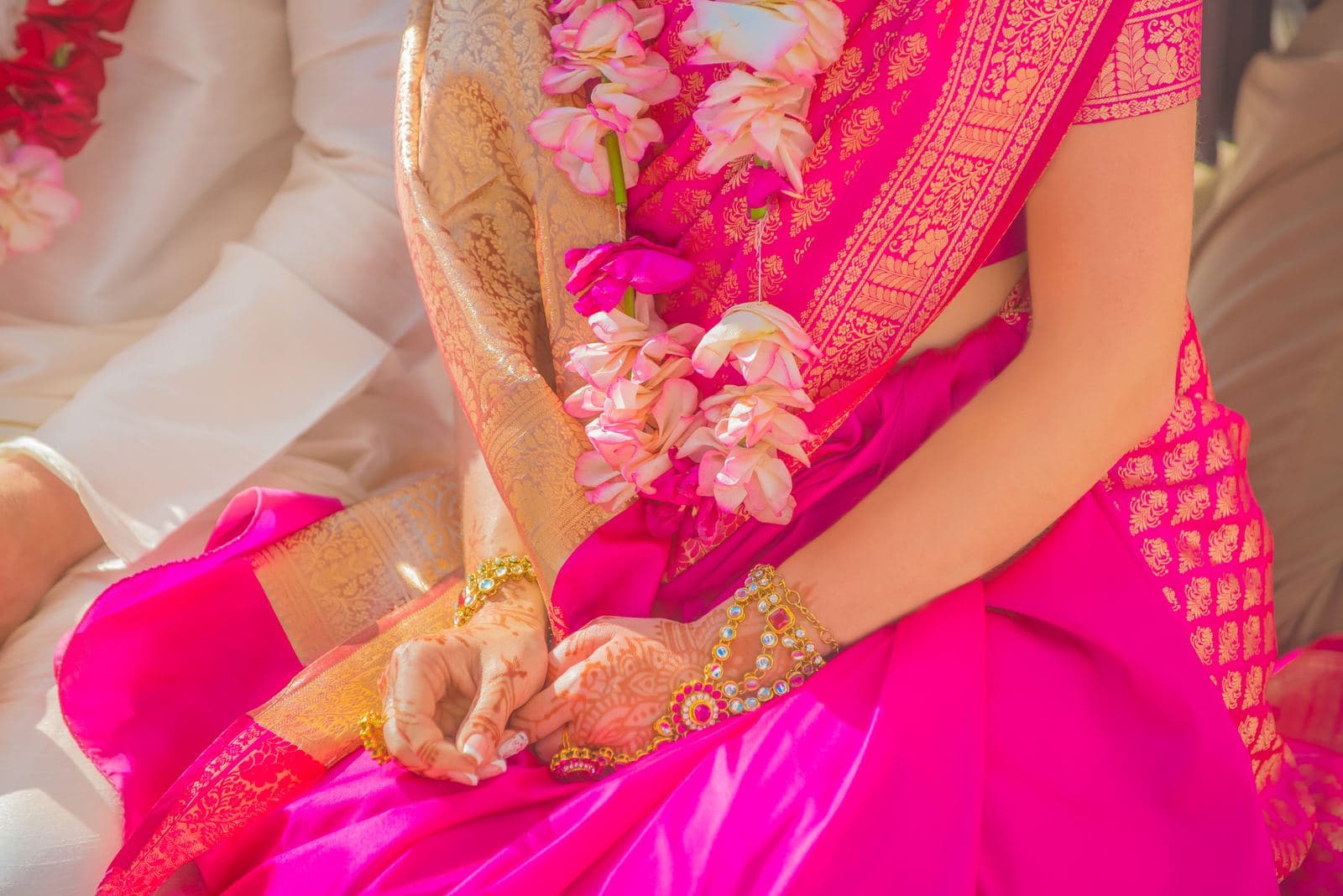
The wedding journey formally begins with Nichayathartham, the engagement. The two families gather, exchange the Lagna Patrika — the written declaration of the match and the muhurtham date — and seal the alliance with blessings from elders. The bride and groom exchange garlands or rings depending on family custom, and plates of fruits, betel leaves, turmeric, and silk are exchanged as thamboolam. In many families a purohit reads the Patrika aloud, making the commitment public and auspicious.
Pandha Kaal Muhurtham and Vratham
A few days before the wedding, both households perform the Pandha Kaal Muhurtham — the ceremonial planting of a consecrated post, traditionally of bamboo or another auspicious wood, at the home or wedding venue. It marks the formal commencement of the festivities and invokes protection so that the wedding proceeds without obstacles.
On the wedding morning comes the Vratham. The groom performs rituals that close his student phase (brahmacharya) and prepare him for the householder's life, while the bride observes rites invoking the blessings of family deities and ancestors. Kappu — a sanctified thread — is tied on the wrists of both, signifying that they are now under a vow and protected until the marriage is complete.
Kasi Yatra: The Playful Turning Point
Perhaps the most charming moment of a Tamil Brahmin wedding is the Kasi Yatra. The groom, dressed simply and carrying an umbrella, a walking stick, and a bundle of provisions, announces that he is renouncing worldly life and leaving for Kasi to devote himself to study and asceticism. The bride's father hurries after him, praises the virtues of married life, and offers his daughter's hand. The groom "relents" and returns. Beneath the laughter is a serious idea: marriage in the Vedic view is not a default but a conscious choice — the groom weighs the path of renunciation and deliberately chooses grihastha ashrama, the householder's path, with all its duties.
Oonjal: Blessings on the Swing
The couple is then seated on a decorated wooden swing — the Oonjal — and gently rocked while the women of both families sing traditional songs. Relatives circle the couple with lamps and colored rice balls, which are thrown in the four directions to ward off the evil eye. The swing's motion carries its own symbolism: life will move back and forth between joy and difficulty, and the couple must stay seated together, steady, through both.
Kanyadanam, Muhurtham, and Mangalya Dharanam
Kanyadanam — the giving of the bride — is regarded as one of the most meritorious acts a parent can perform. The bride sits on her father's lap as he formally entrusts her to the groom, who vows before Agni to remain her companion in dharma, artha, and kama. In many families the bride wears the nine-yard koorai saree for this rite, draped in the traditional madisar style.
Then comes the muhurtham itself — the precise auspicious moment chosen by the astrologer. The groom ties the thirumangalyam (thali) around the bride's neck with the first knot, and his sister completes the second and third, as the Nadaswaram rises to the loud, joyous Getti Melam so that no inauspicious sound is heard. The three knots are commonly understood as binding the couple in thought, word, and deed — commitment to each other, to family, and to shared dharma.
Here the Iyer–Iyengar distinction is most visible. Iyer families, of the Smartha tradition, typically use a thali bearing Shiva-related motifs, while Iyengar families use designs associated with Vishnu — most recognizably the shankha (conch) and chakra (discus). Iyengar ceremonies also weave in Sri Vaishnava elements: recitations from the Divya Prabandham, the presence of temple honors for families with hereditary temple affiliations, and ritual conventions that differ subtly between the Vadakalai and Thenkalai sub-traditions. The essentials, however — fire, mantra, and mangalyam — are common to both.
Saptapadi: The Seven Steps
No Vedic marriage is complete without Saptapadi. Holding hands, the couple walks seven steps together around or beside the sacred fire, each step accompanied by a mantra and a shared aspiration — nourishment, strength, prosperity, happiness, progeny, long life, and lifelong friendship. In the eyes of dharma and of Indian law alike, it is the Saptapadi that completes the marriage. The groom also gently places the bride's foot on a grindstone (ammi), asking her to be as firm as stone, and together they sight the star Arundhati, the emblem of devoted partnership.
Nalangu and Grihapravesham
After the solemn rites, the mood turns playful again with Nalangu, an evening of games between bride and groom — rolling coconuts to each other, fanning, singing, applying sandal paste. These games, watched and cheered by both families, were traditionally the couple's first chance to relax together and let two households mingle as one.
The ceremonies close with Grihapravesham, the bride's formal welcome into the groom's home. She enters right foot first, often gently toppling a vessel of rice at the threshold — a sign that she arrives as Lakshmi, bringing abundance. An arati is performed, and the couple begins married life with the blessings of both families.
Carrying the Tradition Abroad
Tamil Brahmin families in the US, UK, Singapore, Australia, and the Gulf continue to hold these ceremonies with remarkable fidelity — often compressed into a single day for practical reasons. Temples and community halls abroad host the rites, purohits conduct ceremonies in person or guide families remotely, and items like the koorai saree and thirumangalyam are sourced from Chennai or Kumbakonam well in advance. What changes is the logistics; what remains unchanged is the sequence and the meaning. Many diaspora couples say the wedding was their deepest encounter with their own heritage — a reminder that these rituals are not formalities but a living grammar of commitment.
Frequently Asked Questions
What is the difference between an Iyer and an Iyengar wedding?
Both follow the same Vedic marriage framework — Kanyadanam, Mangalya Dharanam, Saptapadi — but the details differ. Iyer (Smartha) weddings follow Smartha ritual conventions and typically use a thali bearing Shiva-related motifs, while Iyengar (Sri Vaishnava) weddings incorporate Sri Vaishnava customs, Vishnu-related thali designs such as the shankha and chakra, and often the recitation of Divya Prabandham verses. Iyengar ceremonies are further divided into Vadakalai and Thenkalai conventions.
What is the meaning of the Kasi Yatra ritual?
Kasi Yatra is a light-hearted ritual in which the groom, dressed as an ascetic with an umbrella and walking stick, pretends to renounce worldly life and leave for Kasi (Varanasi) to pursue spiritual studies. The bride’s father stops him, extols the virtues of the householder’s life (grihastha ashrama), and persuades him to marry his daughter instead. It dramatises the groom’s conscious choice of married life over renunciation.
Why are three knots tied in the Mangalya Dharanam?
During Mangalya Dharanam the groom ties the first knot of the thali (thirumangalyam), and traditionally his sister ties the remaining two. The three knots are commonly understood to represent the bride’s commitment to her husband, to his family, and the couple’s shared duty (dharma) — binding thought, word, and deed. The knots are tied at the muhurtham, the astrologically chosen auspicious moment, while the Nadaswaram plays the Getti Melam.
How long does a traditional Tamil Brahmin wedding last?
A traditional celebration spans two to three days, beginning with Nichayathartham and Vratham rituals, followed by the main wedding day with Kasi Yatra, Oonjal, Kanyadanam, Muhurtham, and Saptapadi, and concluding with Nalangu and Grihapravesham. Many modern families, especially abroad, condense the core rituals into a single day while preserving the essential Vedic rites.
Find a Match Who Shares Your Traditions
MSMatrimony connects Iyer, Iyengar, Telugu, and Kannada Brahmin families — and families from every South Indian community — through verified profiles and Vedic Kundli matching, so your wedding day traditions begin with the right match.